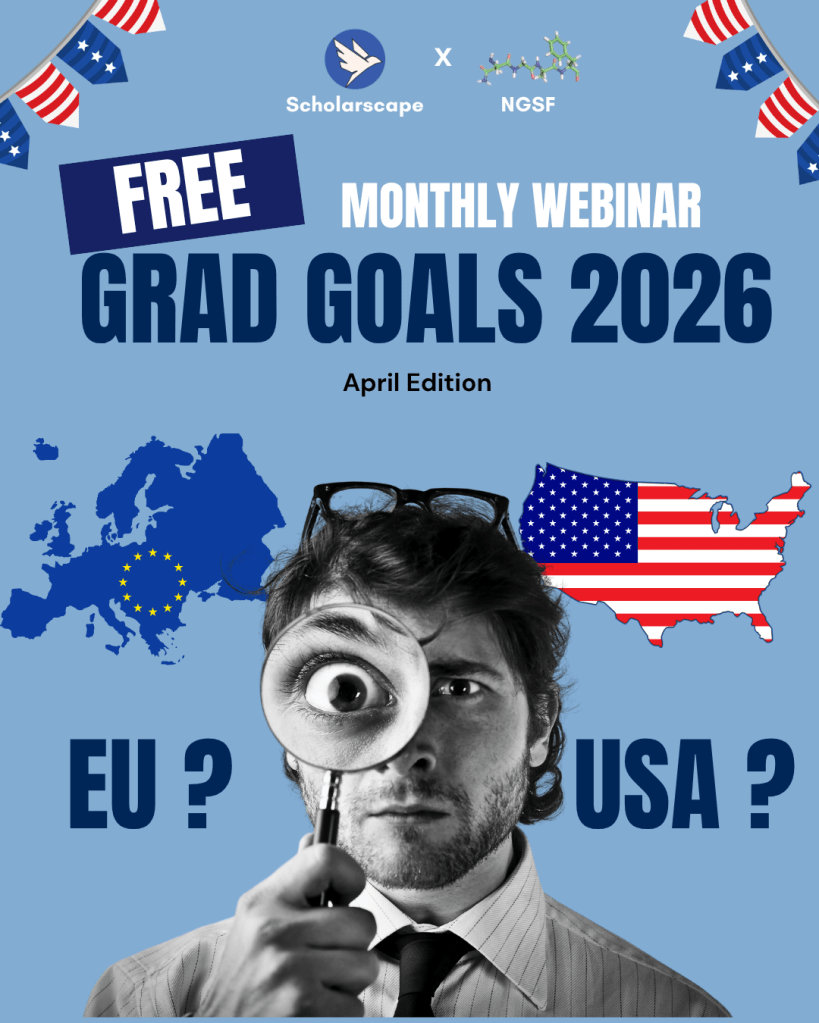
Study abroad plans shouldn’t feel like a maze. Our April edition of the Grad Mentoring Webinar brought together three mentors — Shreaya, Alejandro, and Harikumar — for an hour of honest, experience-backed guidance on masters and PhD journeys abroad. Here’s the distilled version.
Mentors
Shreaya Bhaskar — Masters in Molecular Medicine, Uppsala University, Sweden. Currently a Project Associate at IIT Madras.
Alejandro Mendoza — MSc in Bioengineering, Brazil. Research focus: neural assistance and epilepsy.
Harikumar — Three years of industry experience before a Masters in Medical Research at Heidelberg University, Germany. Now a Junior Scientist at PreviPharma.
When Should You Go?
There’s no universal right time. It depends on your finances, career goals, and what your current environment can or can’t offer you. Shreaya went abroad for research exposure and collaborative infrastructure she felt wasn’t accessible during her undergrad. Harikumar went after industry experience — and says that gap made his application sharper and his time at Heidelberg far more intentional. Both paths worked.
Know What You’re Applying For
Three types of programs to understand before you shortlist anything:
- Taught Masters — structured coursework plus a 6–9 month thesis. Some let you swap courses for research internships.
- Masters by Research — minimal coursework, lab rotations, deep research focus.
- Integrated PhD — enter as a doctoral candidate, with the option to exit with a masters (check the exit clauses). Often well-funded.
Picking a Location
Don’t lead with rankings. Shreaya chose Uppsala without prioritising QS scores — what mattered was the research environment. Evaluate: cost of living, scholarship availability, course breadth, and the specific lab or PI if you’re applying for research-based programs. And don’t underestimate the climate adjustment — it’s real.
The Application Golden Rule
Alejandro framed it simply: every document you submit must answer three questions — why are you applying, how do you fit this program, and how do you match the ideal candidate? That’s your filter for every sentence.
A few specifics:
- CV — education, research experience, and skills. Split technical from soft.
- SOP — formal, objective, specific to each university. Generic gets rejected.
- Personal Statement — your non-academic story. Be authentic, drop the formal register.
The single most common mistake: sending the same documents everywhere. Committees can tell.
On AI: Using it to brainstorm is fine. Using it to write your SOP is not — universities run detection tools and AI-written applications are being rejected outright.
While You Wait
The 6–12 weeks between submission and response isn’t downtime. Harikumar’s advice: go back to your bachelors fundamentals, know your cited projects inside out, identify skill gaps and close them on Coursera or LinkedIn Learning, and start networking with alumni or seniors already in that course or country. Five genuine connections beat a hundred cold follows.
From the Q&A
Some of the most useful moments came from attendees. A few highlights:
- Final semester — when do I apply for Fall 2027? Check the specific intake (some programs start in September, others in March). You don’t need your degree yet — a confirmed graduation date is enough. When unsure, email the program director directly.
- How do I fund a masters without burdening my family? Target programs with free or low tuition (Germany is the go-to). But plan for living costs separately — many scholarships cover tuition only.
- How do I cold email a professor for a PhD? Read their work, cite something specific, identify a gap, and ask directly if they have funding. Harikumar’s tip: postdocs and senior PhD students are often more approachable than PIs — and more likely to tell you honestly what’s actually available.
- Does my Biotech degree give me an edge? No — committees don’t weight degrees against each other. Skill set alignment and research experience are what matter. A clear, honest story about why you’re switching domains matters more than the degree name.
- What about industrial PhDs? They exist at companies like Roche and Merck but don’t follow academic timelines — positions open when projects are signed. Follow big pharma LinkedIn pages, network actively, and look at universities with strong industry tie-ups like Germany’s Fraunhofer institutes or Denmark’s academic-industry joint positions.
Specificity wins — in your program choice, your documents, and your story. The students who struggle are usually the ones who haven’t decided what they actually want yet. This webinar was a step toward that clarity.
Watch the full session here and share it with anyone navigating their study abroad journey!
Visit us
scholarscape.org
scholarscapeorg@gmail.com

